
How to use Vitamin D3+K2 GuideUpdated 8 months ago

Vitamin D is actively used by nearly every cell in your body. When not exposed to the sun or eating fatty foods, one may become vitamin D deficient. A deficiency of vitamin D brings about many health problems.
Research has shown that vitamin D3 supports the following areas of health:†
| • Skin1 | • Healthy mood7 |
| • Hair2 | • Heart8,9 |
| • Bones3,4 | • Lungs10 |
| • Teeth5 | • Immune system11, 12 |
| • Brain6 | • Muscles13 |
How does vitamin D3 support these areas of health?†
• Supports healthy calcium metabolism and mineralization
• Supports healthy blood sugar
• Supports normal immune system function and inflammatory responses
• Supports healthy blood pressure
• Supports healthy cholesterol and blood lipid levels
Foods that contain vitamin D3:
Wild salmon (500 IU to 1000 IU per 3.5 oz)
• Sardines (300 IU per 3.5 oz)
• Canned tuna (270 IU per 3.5 oz)
• Herring (200 IU per 3.5 oz)
• Halibut (200 IU per 3.5 oz)
• Beef liver (50 IU per 3.5 oz)
• Egg yolk (25 IU per large egg)
How much vitamin D3 should you take?
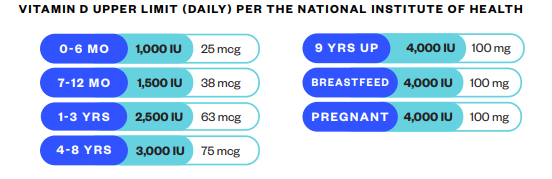
• The daily upper limit on vitamin D is very conservative and safe.
• Healthcare professionals commonly recommend higher doses than the upper limit.
• Ask your healthcare professional how much you should take.
Is there an upper limit of vitamin K2?
• There is currently no established upper limit of vitamin K2.
• It is not known to be toxic.
Take vitamin D3 especially if:
• You spend the majority of your time indoors
• You are avoiding sun exposure
• You’re older, have darker skin or are obese as these factors reduce natural vitamin D synthesis from the sun22
• You don’t eat too many foods with vitamin D or K in them
• You live in areas of low sunshine
• From October to April, if you live in northern latitudes 37th parallel (Seattle, NYC)
• Have blood levels of vitamin D less than 20 ng/ml (50 nmol/L)
What is an ideal blood level of vitamin D3?
• It depends on you and your needs.
• For most people, a good amount of vitamin D3 in the body usually falls between 40 and 70 ng/mL. However, you may have genetic differences that require higher levels of vitamin D3 to get the same health benefits.
Who can take vitamin D3:
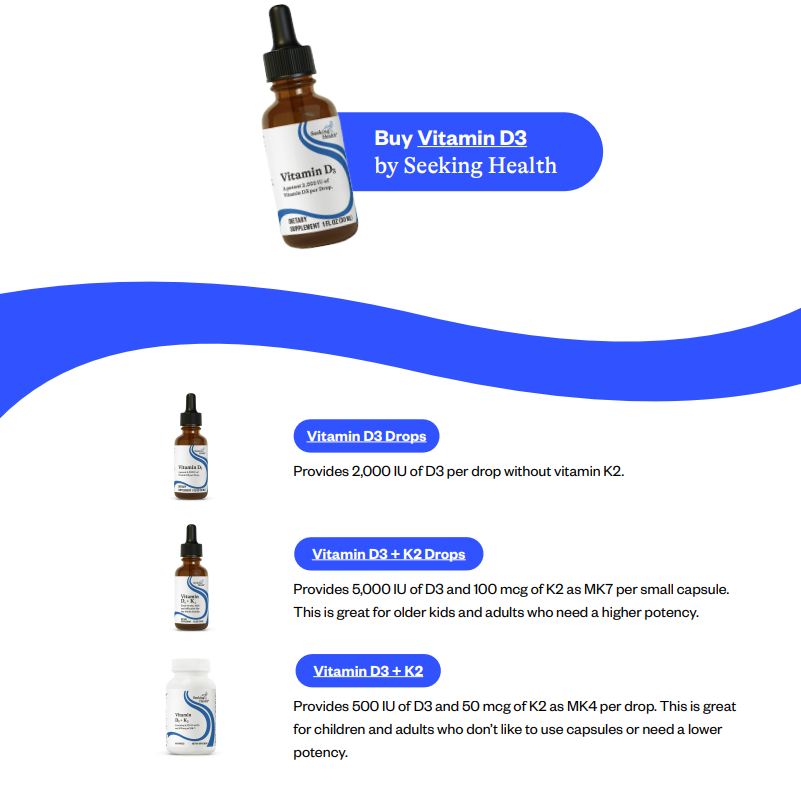
• Vitamin D3 + K2 Drops provides 500 IU of D3 per drop. This may be used by kids 1 year old and up.
• Vitamin D3 Drops can be taken by kids 4 years and up.
• Vitamin D3 + K2 capsules can be taken by kids 4 years old and up
How to take vitamin D3:
• Take after eating some food any time of day or night.
• Take the vitamin D drops directly by mouth or put them onto a bite of food.
• Do not put the liquid drops into a smoothie or juice as you likely won’t get the dosage as it may stick to the side of the container
When to stop using vitamin D3:
• When starting a supplement, this is when the body is most likely in need of it.
• Adjust your dose as needed once your body is adequately supported, or even stop completely.
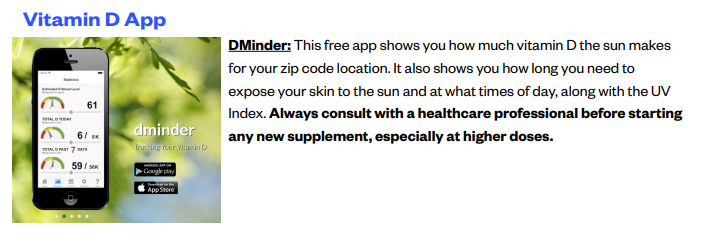
• You may not need to supplement with vitamin D3 during the summer months especially if you are outside daily and have 25% of your skin exposed to the sun’s peak.
• Consult with your healthcare professional about what works best for you.
• Stop if you start showing signs of excessive use of vitamin D3.
Side effects and signs of excessive use of vitamin D3 include:
• Elevated levels of vitamin D in the blood (exceeding 100 ng/mL)
• Elevated blood calcium levels
• Gastrointestinal symptoms, such as abdominal pain, nausea, vomiting, constipation or diarrhea, and loss of appetite
• Excessive urination
• Abnormal heart rhythms
• Mental confusion, hallucinations
• In more severe cases, kidney stones, kidney injury, or even kidney failure
How to counter side effects of vitamin D3:
• Consult a healthcare professional.
• Include foods that are high in magnesium, vitamin K2, vitamin B2, vitamin B6, and zinc in your diet to support vitamin D metabolism. Good options are leafy green vegetables, fruits, nuts and seeds.
• Keep your electrolytes balanced.
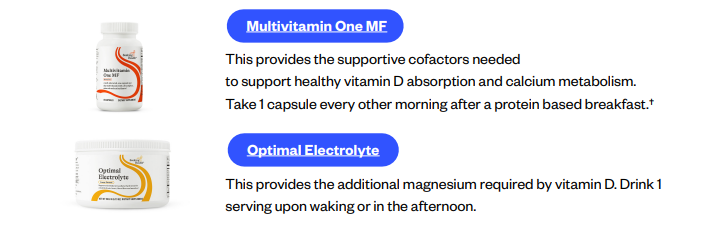
• Supplement with essential vitamin D cofactors such as magnesium, K2, B2, B6, boron, and zinc if needed to restore healthy levels of these nutrients.†
• Discontinue use or reduce the dosage or reduce the frequency of use, depending on the severity of symptoms
• Increase hydration
• Repeat lab testing should be done in 3 months
When to get lab testing for vitamin D3:
• Ideally, before first use, measure to get a baseline of your vitamin D3 level.
• After starting vitamin D, retest in 3 months.
• Vitamin D levels may take three to six months to reach a steady level.
• Once stable and the correct dose is identified, once-a-year testing is typically sufficient.
• Note: vitamin D3 testing measures the inactive form of D3 not the active 1,25 OH D3.
When to be careful with vitamin D3:
• Magnesium deficiency can be amplified by taking vitamin D especially in higher doses. Be sure to supplement with sufficient magnesium when taking vitamin D3.23
• If you have any condition or disease that affects vitamin D metabolism, such as sarcoidosis, hyperparathyroidism, lymphoma, and kidney diseases.
• If you make use of any medication that may interact with vitamin D, such as atorvastatin, phenobarbital, phenytoin, and other anticonvulsant medications.
• If you have elevated calcium levels, stop taking vitamin D3 and take vitamin K2 only.
• Know how much D3 is in each of the supplements you take frequently. Many people take a multivitamin, immune support, and a vitamin D supplement. This can lead to potentially too much D3, especially if they do not use vitamin K2 with it.
• It’s ok to take vitamin D3 without vitamin K2 if you are getting K2 in food or you’re getting K2 in other supplements like your multivitamin. You don’t have to take vitamin D3 with K2 at the same time. You can take them separately.
How long does vitamin D3 stay in the body?
The duration of these is highly dependent on the individual. Things like inflammation and genetic variations can speed up the elimination of D3.
• The typical half-life of 25 OH D3 is about 15 days. So half of vitamin D3 is gone in 15 days.14 Example: Say your blood level is high at 100 ng/mL, and you want it to be at 70 ng/mL. Mathematically, using a consistent 15-day half-life, it will take about 8 days. However, realistically, it may take weeks to months, depending on multiple factors such as sun exposure, diet, lifestyle, race, skin type, and obesity status.
Do you have to take vitamin K2 at the same time you’re taking vitamin D3?
• No. These are both fat soluble vitamins. You can take them separately.
• Vitamin K2 is commonly found in a quality multivitamin in sufficient amounts.
• You can take just a vitamin D3 supplement along with your multivitamin.
• You can take the multivitamin after breakfast and the vitamin D after dinner.
How long does vitamin K2 stay in the body?15
• MK4 half-life is fast at 2 hours.
• MK7 half-life is slower at 3 days.
 Supportive supplements for vitamin D3
Vitamin D activation and calcium metabolism requires additional nutrients such as vitamin K2, zinc, boron, magnesium, vitamin B2, and vitamin B6.16, 17, 18, 19† Many of these nutrients are found in a multivitamin and electrolytes.
 Weak Digestion? Intolerant to Fatty Foods?
• Vitamin D3 and K2 are fats.
• Weak fat digestion is a common cause of vitamin D deficiency.
• If you have weak digestion or struggle to absorb fats and want to support healthy digestion, you may need to take Vitamin D3 + K2 supplements with a meal, along with: Digestive Enzymes: Support fat breakdown for proper absorption.†
 1. https://pubmed.ncbi.nlm.nih.gov/21034990/
2. https://pubmed.ncbi.nlm.nih.gov/34553483/
3. https://www.ncbi.nlm.nih.gov/pmc/articles/PMC3257679/
4. https://pubmed.ncbi.nlm.nih.gov/36033779/
5. https://www.ncbi.nlm.nih.gov/pmc/articles/PMC3257679/
6. https://www.ncbi.nlm.nih.gov/pmc/articles/PMC6132681/
7. https://pubmed.ncbi.nlm.nih.gov/32365423/
8. https://pubmed.ncbi.nlm.nih.gov/31407792/
9. https://pubmed.ncbi.nlm.nih.gov/34785587/
10. https://www.ncbi.nlm.nih.gov/pmc/articles/PMC3559187/
11. https://www.ncbi.nlm.nih.gov/pmc/articles/PMC7281985/
12. https://pubmed.ncbi.nlm.nih.gov/34827621/
13. https://www.ncbi.nlm.nih.gov/pmc/articles/PMC4530385/
14. https://pubmed.ncbi.nlm.nih.gov/18689406/
15. https://pubmed.ncbi.nlm.nih.gov/34472618/
16. https://pubmed.ncbi.nlm.nih.gov/29138634/
17. https://pubmed.ncbi.nlm.nih.gov/29480918/
18. https://pmc.ncbi.nlm.nih.gov/articles/PMC9095729/
19. https://pmc.ncbi.nlm.nih.gov/articles/PMC4712861/
20. https://pubmed.ncbi.nlm.nih.gov/32567290/
21. https://pmc.ncbi.nlm.nih.gov/articles/PMC4516990/
22. https://diabetesjournals.org/spectrum/article/24/3/148/32305/VitaminD-Deficiency-and-Type-2-Diabetes-in?t
23. https://pubmed.ncbi.nlm.nih.gov/28471760/
†These statements have not been evaluated by the Food and Drug Administration. This product is not intended to diagnose, treat, cure, or prevent any disease