
How to use Optimal FocusUpdated 8 months ago
Acetylcholine is your brain’s #1 calming neurotransmitter—by far. Your brain utilizes acetylcholine to help you learn new things, recall names and places, keep your memory sharp, your focus dialed in, your bowels moving, and even support healthy muscle movement. It’s also a key player in REM sleep, which is the time your brain processes and stores new information.1
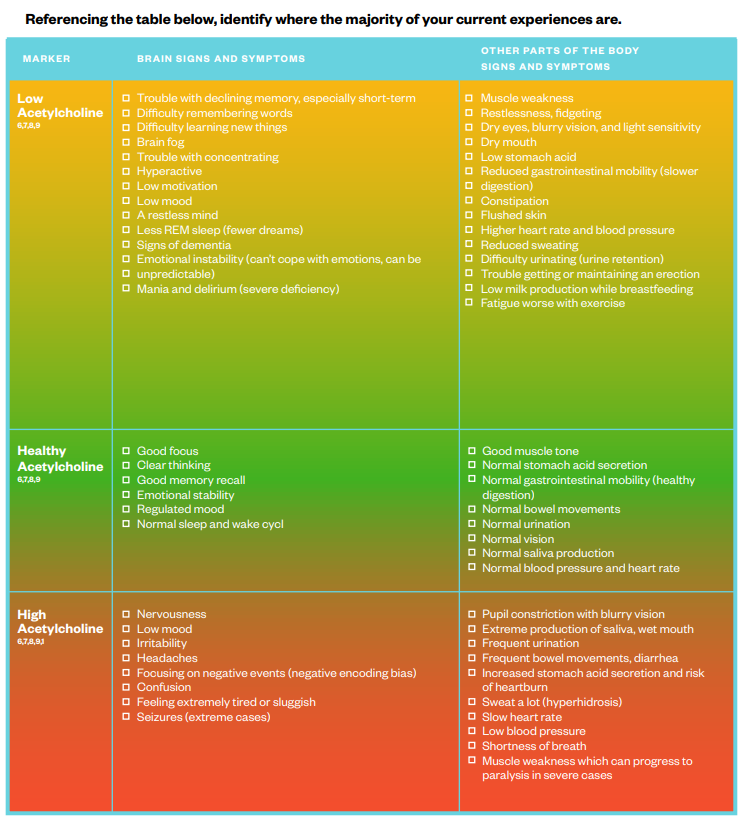
When acetylcholine levels drop, you may feel mentally foggy, struggle to focus, have difficulty learning new things, experience constipation, move more rigidly, forget names and events, or notice that you don’t dream as much.2
Several factors can contribute to low acetylcholine, including aging, inflammation, genetics (like the APOE4 gene), vegetarian or vegan diets, and exposure to certain pesticides.3,4
Some health conditions, such as difficulty with hyperactivity, dyslexia, spectrum disorder, myasthenia gravis, and dementia, have also been linked to low acetylcholine levels.5, 21 Keeping this neurotransmitter in balance is essential for staying sharp and supporting long-term brain health!
The positive effects of supporting healthy acetylcholine levels are subtle: paying attention, focusing, listening, not switching or interrupting, being calmer in prior stressful situations, better sleep, and the ability to learn more easily.
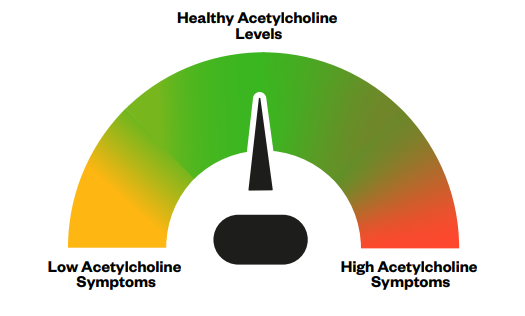
How Is Your Acetylcholine Doing? Check!
 How to Support Healthy Acetylcholine Levels
If needing to support healthy acetylcholine levels, choose the supplement that aligns best for you and
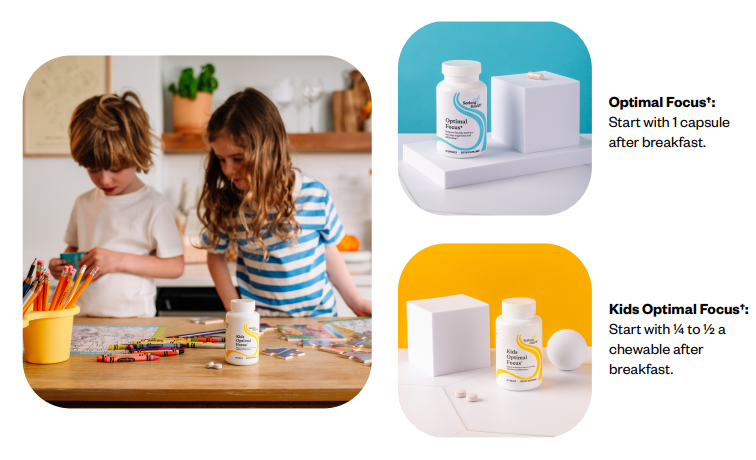
Optimal Focus†: Best for ages 14 and older. In capsule form.
Kids Optimal Focus†: Best for kids 4 and up to adults. In chewable tablet form. Perfect for those who desire lower potency. 2 chewables is equivalent to 1 capsule of Optimal Focus.† The only difference: does not contain ginseng or DHA (tastes bad).
Tip: Having 1 bottle of each allows for more flexible dosing. This way, if you need less than 1 capsule of Optimal Focus†, you can break a Kids Optimal Focus† chewable into smaller pieces.
How to Use Optimal Focus†:
For the past couple of years, Dr. Lynch has learned how people typically respond to this supplement. Following these suggestions supports beneficial outcomes.†
Day 1: The first time taking it is the most powerful, so start with a smaller amount than the suggested serving on the bottle.
 The effects of the supplement are typically noticeable on the same day. The effects tend to last 24 hours. 3
Typical Suggested Usage Schedule:
Most people age 14 and older do well with a simplified dosing schedule using Optimal Focus† capsules.
These are examples of various common usage schedules people use successfully:
• Take 1 capsule each day for 5 days, and do not take it on weekends
• Take 1 capsule every other day
• Take 1 capsule every two days
• Take 1-2 capsules on an as-needed basis only (this is how Dr. Lynch and his sons use it)
For more sensitive people, an alternative usage schedule is suggested.
Use the Kids Optimal Focus† instead of the capsule of Optimal Focus† as it allows you more freedom in how much you’re taking.
• For younger kids, 4 to 8 years old, start with a ¼ tablet.
• For kids 9 to 13, start with ½ a chewable.
• If sensitive in general, start with ¼ a chewable. You can always take more of a supplement, but can never take less once swallowed.
• Once taken, observe your child or yourself over the course of the day, starting within 20 minutes of taking.
• Each day, reduce the amount you’re taking by ½ what you took the day prior. If taking 1 chewable, then take ½ the next day and ¼ the third day. Do not take any more the rest of the week.
• Use on an as-needed basis only. Some days, you’ll need more, and other days, you’ll need less. Best to take ¼ to ½ a chewable, wait 20 minutes to see how you feel and take another ¼ to ½ if feeling you need more.
• You can always increase to a full serving size, but you can’t take it back after you’ve already consumed it.
• Take as recommended by your healthcare professional
Real-life Usage Scenarios:
1. A 5-year-old child does very well with ½ a Kids Optimal Focus† on day 1, ¼ on day 2, and on day 3 just a tiny bit, followed by a day off.
2. My son, age 16, uses Optimal Focus† and takes 1 capsule on the days when he has a lot of studying to do. He’s currently in a college program during high school, so it’s demanding. When he has an exam that day, he takes 1 capsule of Optimal Focus† with 1-2 capsules of Stress Nutrients. Typically, he uses 2-3 times per week.
3. An 18-year-old baseball pitcher takes 1 capsule before important games, which would otherwise stress him out. He finds himself in a healthy, calm, focused state despite the pressure.† 4. A professional surfer takes 1-2 capsules before big surf competitions so he can ‘lock in’.†
5. I, Dr. Lynch, use Optimal Focus† when I feel like I’m switching tasks too much and need to dig in and work on a focused single project. Otherwise, I just use ½ to 1 chewable of Brain Nutrients most mornings to start my day.
6. A 20-year-old college student likes using 1-2 capsules of Optimal Focus† with 1 capsule of Dopamine Nutrients
 An Interesting Discovery
The longer people continue using this supplement, the longer the beneficial effects tend to last.†
• At first, you may experience that taking 1 capsule of Optimal Focus† daily for 5 days on and 2 days off works well for you.
• A month or two later, you may find that it’s too much for you.
• Adjust to taking it only 3 times a week. That works well for some time.
• If that is still too much, take it on an as-needed basis only. Here’s one possible reason why people need less support over time:
• Acetylcholine naturally supports healthy inflammatory processes in the brain.
• As inflammation becomes more controlled, the need for Optimal Focus† may lessen.†
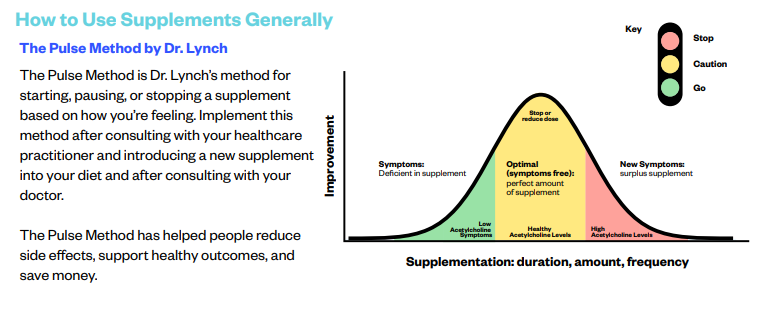 What Does It Mean To Supplement
The word supplement literally means “to add to or enhance”. Supplementation is used to “top off” nutrients you should already receive daily from eating though sometimes you may not. It is also a tool to aid the body in supporting nutritional balance, which can be offset due to poor food quality and a lack of essential vitamins and minerals.
How to Further Optimize Your Acetylcholine
• Eat more choline. Incorporate choline-rich foods such as meat and eggs into your diet. Choline is needed to make acetylcholine. It is water-soluble, meaning it doesn’t store in the body and must be consumed regularly to prevent deficiency. Only 11% of adults are getting sufficient choline in their diet.15 Vegans and vegetarians may be at risk of choline deficiency unless they consume plant-based forms such as soy or sunflower lecithin.16 Choline requirements increase dramatically during pregnancy. Over 90% of pregnant women are deficient in choline, which may contribute to ‘baby-brain’ typically experienced by mums whilst pregnant.38
• Avoid organophosphate exposure in all life stages—especially pregnancy, breastfeeding, and young children as their brains are developing. This toxic compound is commonly used in pesticides and insecticides. Organophosphates interfere with the breakdown of acetylcholine. This allows for acetylcholine levels to increase in the developing brain, which then causes the acetylcholine receptors to decrease in number. Reduced acetylcholine receptor availability leads to reduced acetylcholine function. The reduced acetylcholine activity leads to symptoms of low acetylcholine.40 Certain genetic variations increase the susceptibility to organophosphate toxicity, so it’s simply best to limit exposure.41 Buy organic, grow your food, avoid the Dirty Dozen, or buy the Clean Fifteen, which is not organic, to save money while limiting exposure.
• Food coloring is suspected to contribute to acetylcholine dysfunction. Research is conflicted.42 Food additives, such as food coloring, are known to cause issues such as food additive intolerance.43 Given the potential issues, limiting exposure to food coloring is best. Some children are going to be more sensitive to it than others.
Life Events Associated with Low Acetylcholine
Nicotine and Acetylcholine: From Vaping, Nicotine Pouches and Patches, and Cigarettes There is a significant biochemical reason why people turn to vaping, nicotine pouches or patches, or smoking cigarettes. Nicotine mimics the actions of acetylcholine in the brain. Improved cognitive function occurs when nicotine binds to the same acetylcholine receptor family.11 If one naturally supports healthy acetylcholine levels, then the need for nicotine decreases.
If one continues using nicotine substances long-term, they may desensitize their acetylcholine receptors. This is not good as their ability to focus, learn, and concentrate goes down. This drives a higher need for nicotine, which in turn further desensitizes acetylcholine activity—a vicious cycle.11 For this reason, it’s not uncommon for smokers to experience some memory symptoms when they give up smoking after many years.
It’s important to support healthy acetylcholine levels on an as-needed basis. This keeps your acetylcholine receptors healthy and sensitive, allowing your brain to function well.†
Learning Disabilities and Acetylcholine: Dyslexia, Hyperactivity, and General Learning Difficulties
Acetylcholine is absolutely required for learning and neurodevelopment. If acetylcholine levels are deficient, then learning is as well. Research shows that dyslexia, hyperactivity, and generalized learning difficulties are often associated with low acetylcholine levels.21,22, 23
Acetylcholine also interacts with another important neurotransmitter involved in focus and learning—dopamine. Dopamine helps to process information, and acetylcholine stores this information into memory for later recall. Both dopamine and acetylcholine help you focus. Acetylcholine receptors are found on dopamine-producing brain cells, and dopamine receptors are found on acetylcholine-producing brain cells. In this way, they stimulate each other’s release from brain cells as needed in waves and regulate each other to maintain healthy levels.
Spectrum Disorder and Acetylcholine
Researchers have confidently identified that individuals on the spectrum are deficient in acetylcholine.24, 25, 26 This makes sense as inflammation is present in those with a spectrum disorder. Higher inflammation leads to greater acetylcholine destruction and increased brain inflammation. Parents who support healthy acetylcholine levels in their children on the spectrum have reported immediate beneficial outcomes.
Long-Term Negative Effects From Viral Infections
Acetylcholine is a natural anti-inflammatory for the brain.4 It’s so effective that researchers have named it the ‘Cholinergic Anti-Inflammatory Pathway.’ The problem is that inflammation itself damages acetylcholine. Certain viruses are known to significantly increase inflammation in the brain, which then activates the destruction of acetylcholine-producing brain cells (cholinergic neurons). The more acetylcholine neurons are reduced in the brain, and the less acetylcholine is released, the more damaging the inflammation. Again, another vicious cycle.
Research shows that using nicotine or cholinesterase inhibitors (slow the breakdown of acetylcholine) supports those struggling with the long-term adverse effects caused by certain viral infections.
Research needs to look into supporting healthy levels of acetylcholine production in these individuals.
APOE 4 Variants: Dementia, Learning Difficulties, and Acetylcholine
The APOE4 genetic variation is associated with an increased risk of dementia.12,27 This variation increases the risk of low acetylcholine activity in the brain, which drives up the risk for inflammation and, as a result, memory loss.13
Additionally, APOE4 is associated with reduced cholinergic activity, which is associated with acetylcholine activity. This reduced cholinergic activity (i.e., low acetylcholine levels) leads to learning difficulties in children, especially girls, and dementia in adults.28, 29
As with long-term viral infections, those with APOE4 variations experience significant memory and attention improvement when using nicotine.14 Research needs to look into supporting healthy levels of acetylcholine production in individuals with APOE4 variations.
Menopause and Andropause Effects on Acetylcholine
Declining levels of hormones negatively influence acetylcholine levels
In women, estrogen levels—specifically estradiol—decrease during perimenopause and menopause. In males over 30, testosterone levels begin to decrease.
The loss of estradiol is associated with decreased cholinergic activity, less acetylcholine release, and reduced acetylcholine binding to their receptors, which impacts attention and memory.30 Reduced acetylcholine receptor binding on dopamine-producing brain cells may also negatively affect dopamine release. It’s no wonder that many menopausal women complain of poor memory, loss of libido, and low mood.
Even though there seems to be less evidence for lower testosterone’s effect on acetylcholine levels compared to lower estradiol effects, some studies have found increased acetylcholine levels with testosterone treatment in biological males.31
Adrenal Fatigue and Acetylcholine
DHEA (dehydroepiandrosterone sulfate) is an adrenal neurosteroid hormone that increases acetylcholine release in the brain and has a significant influence on memory and cognitive function.32, 33, 34 DHEA itself can be converted to estradiol and testosterone, but not if it’s in low amounts.
DHEA levels typically decrease as we age and during inflammation, which may further reduce acetylcholine release.35, 36, 37 Less acetylcholine leads to more inflammation and eventually even less acetylcholine production and release.
Interactions with Medications
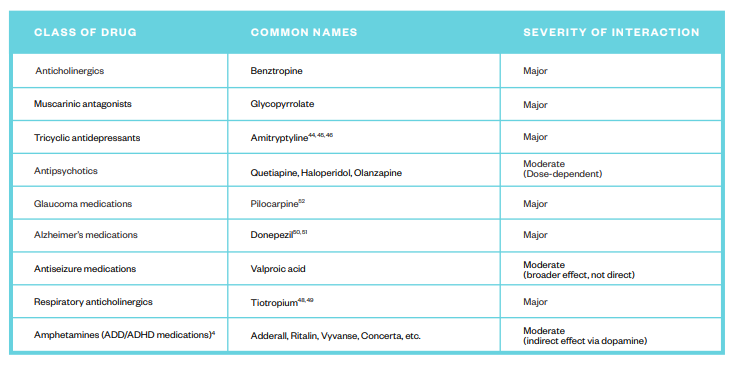
Do NOT use Optimal Focus† or Kids Optimal Focus† if using these medications.
Here are some common medications that contraindicate the use of Optimal Focus† or Kids Optimal Focus†. This list is not exhaustive. Talk with your healthcare professional to ensure there are no interactions.
 Caution: Blood pressure medications.
It’s not contraindicated to use Optimal Focus† if on blood pressure medications. However, it is important to know of possible interactions. Monitor your blood pressure, and always consult with your healthcare professional about product interactions. Healthy acetylcholine levels may lower blood pressure even further.17
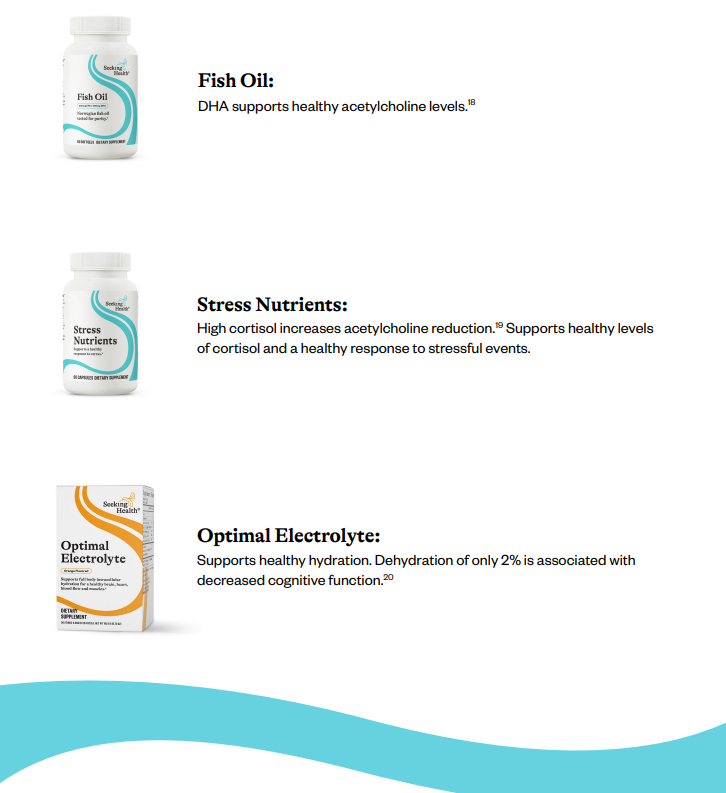
Supportive supplements for Optimal Focus† or
Kids Optimal Focus†
FAQ’s
Do I take this every day?
Optimal Focus and Kids Optimal Focus should be used on an as-needed basis. Take when one has low acetylcholine symptoms (in the chart above) and needs to support healthy acetylcholine.†
Suggested use says to take 5 days on with 2 days off. Is that a must?
The key here is to use it as needed, and when not, don’t use it. If you need it daily, then use it for up to 5 consecutive days with a 2-day break. It’s essential to rest your brain from nootropics stimulating your brain. If your brain is constantly receiving stimulation, it will protect itself by not responding to the supplement, thereby losing effectiveness.
How will I know it’s working?
Typically, within an hour, you’ll find yourself working on a task longer than you usually do without switching from one thing to another. Learning is easier, words come out easier without having to search for them, and your mind is going at a nice calm pace vs high speed.†
It may be a teacher, family member, or friend who says, “You’re on top of things today!”
What are the potential side effects of Optimal Focus† or Kids Optimal Focus†?
• It’s not really a side effect, but rather too much acetylcholine.
• Common side effects are headaches, irritability, loose stools, and muscle cramps.
• Not taking as much or as often is usually the solution.
There may also be something else you need to address before you get the benefits. Or maybe you are missing the ‘brakes’ which keep acetylcholine balanced. Refer to the ‘Troubleshooting’ section further below.
Can I take Optimal Focus† or Kids Optimal Focus† while pregnant?
• No, sadly. The herbs may be unsafe for pregnancy.
• However, you can take it after giving birth if you had significant symptoms of ‘baby-brain’ during your pregnancy and want to support healthy focus.†
Can I take Optimal Focus† while breastfeeding?
• Yes.
I tried Optimal Focus†, or my kid tried Kids Optimal Focus†. We didn’t experience any benefit.
• It may be that you need to use Dopamine Nutrients instead to support healthy dopamine levels.†
• Consider Dopamine Nutrients.
Can I take Optimal Focus† and Dopamine Nutrients together?
• Yes.
• Typically, one or the other should be enough.
- Optimal Focus† stimulates healthy dopamine release.†
- Dopamine Nutrients regulates acetylcholine release.†
• There are situations where taking both may be needed. Here are two common scenarios when individuals may take both at the same time†:
- Studying many hours for a big exam or preparing
- Working on a large project 11
• If taking both Optimal Focus† and Dopamine Nutrients together, consider:
- Doing this periodically.
• If doing this often, the significant amount of brain stimulation will reduce the long-term beneficial effects.
- When combining both, consider taking ½ the amount of each that you usually take when taking them alone. For example:
• If you usually take 2 capsules of Optimal Focus†, take 1.
• If you usually take 2 capsules of Dopamine Nutrients, take 1.
• If you usually take 1 capsule of either one solo, and you feel you need more support, then combining 1 capsule of each is ok.
Can I try Optimal Focus† with Brain Nutrients, Folinic Acid, or Methylfolate?
• Yes.
• Supporting healthy biopterin levels via Brain Nutrients or various types of folate supports healthy neurotransmission.†
• This is an excellent combination that is often used.
• Dr. Lynch and his son periodically use Optimal Focus† x 1 capsule with Hydroxo B12 with Folinic Acid Lozenge when they feel they need additional support.†
Troubleshooting Why Optimal Focus† may not be working for me
It could be one or more of the following scenarios
I am or used to be a long-term smoker.
Nicotine binds to your acetylcholine receptors while exposed, which prevents acetylcholine from binding to them instead.
• Stop using nicotine.
• If you are struggling to give it up and have an addictive personality, add in Dopamine Nutrients. Dopamine Nutrients supports a healthy response to cravings. Refer to the “Can I take Optimal Focus† and Dopamine Nutrients together?” FAQ for further guidance.†
Nicotine makes your acetylcholine receptors less sensitive over time. Even when you stop smoking, your receptors remain lazy for a period of time, and acetylcholine won’t bind as well as it should.
• You may need the higher-end dose (3 capsules) of Optimal Focus† to feel its effects.†
• If you are already taking this dose, you may need to give your receptors more time to become more sensitive.
I’ve been stressed and under pressure for years because of my ___ job, relationship, or trauma.
If stress levels and cortisol stay high for too long, acetylcholine-producing brain cells become damaged. Acetylcholine production decreases, and receptors become ‘numb’ and don’t respond as well.
• You may need the higher-end dose (3 capsules) of Optimal Focus† to feel its effects.†
• Take Adrenal Cortex 1 capsule in the morning with some food.†
Why Optimal Focus† makes me feel worse
It could be one or more of the following scenarios.
I drink coffee or consume caffeine a short time before or after taking Optimal Focus†. Caffeine (1-2 cups of coffee) temporarily boosts acetylcholine levels. If you are consuming coffee too close to taking Optimal Focus† it may increase acetylcholine levels too much.
• Take Optimal Focus† away from any caffeinated beverages or supplements.
You may have low serotonin levels.
Serotonin keeps acetylcholine balanced and prevents too much from flowing freely in the brain. Too much acetylcholine is overstimulating.
• Take Serotonin Nutrients to provide the ‘brakes’ on acetylcholine. Do not use if you are on any serotonin-enhancing drugs such as SSRIs or SNRIs.†
• Take Brain Nutrients to support biopterin production. This is especially true if your dopamine levels are also low.†
You may have high serotonin levels.
Serotonin interacts with acetylcholine differently in the gut than in the brain. In the gut, serotonin stimulates the release of acetylcholine. If you experience gut symptoms such as diarrhea and cramping, it may be that you have higher serotonin levels, amplifying acetylcholine’s action.
• Don’t take Optimal Focus† if you are on serotonin-enhancing medications such as SSRIs or SNRIs.
• If you’re not, your MAO gene may be slow. Take Riboflavin 1 capsule per day.†
• High histamine could also make more work for MAO and slow it down. See below support for high histamine.
You may have high glutamate levels.
Acetylcholine increases glutamate release. Typically, they work together for healthy learning and memory. But if you have high glutamate levels or high exposure to glutamate foods such as MSG, taking more acetylcholine may increase levels further. Glutamate can also stimulate more acetylcholine release.
Having both high acetylcholine and glutamate overstimulates the brain.
• Take Magnesium Plus 1 capsule per day. It contains both active vitamin B6 and magnesium to help support balanced glutamate levels.†
• Lithium Orotate at 1 capsule with food a day supports healthy glutamate levels.†
You may have low GABA levels.
GABA is released with acetylcholine and acts as the ‘brakes’. If the ‘brakes’ are not there, acetylcholine is allowed to flow freely and overstimulate the brain. Low GABA is commonly associated with high glutamate levels. Glutamate converts into GABA with magnesium and vitamin B6.
• Take Ashwagandha 1 capsule with or without food any time of day.†
• Take Magnesium Plus 1 capsule per day, especially if you also have high glutamate levels.†
You may have low dopamine levels.
Dopamine reduces acetylcholine release if there is too much acetylcholine floating around. Dopamine keeps acetylcholine levels balanced.
• Take Dopamine Nutrients. Refer to the “Can I take Optimal Focus† and Dopamine Nutrients together?” FAQ for further guidance.†
• Take Brain Nutrients to support biopterin production. This is especially true if your serotonin levels are also low.†
I have allergies and symptoms of high histamine.
Histamine stimulates the release of both acetylcholine and glutamate. This is the tri-fecta of neurotransmitters that have the capacity to overstimulate the brain if too high.
• Take Histamine Nutrients 1-2 capsules a day with food.†
• You may need further histamine support depending on your symptoms.
Females: I’m estrogen dominant and suffer from endometriosis/PCOS.
Estrogen increases the release of acetylcholine and histamine.
• Take Histamine Nutrients 1-2 capsules a day with food.†
• Take DIM+I3C 1 capsule a day.†
I’m under quite a bit of stress at the moment because of my job/relationship issues. Acetylcholine stimulates cortisol release from your adrenal glands, and cortisol stimulates more acetylcholine release. This occurs during short-term stress.
• Don’t take Optimal Focus† during this period. You can restart when your life is more balanced.
• Take Stress Nutrients, Ashwagandha, or Phosphatidyl Serine in the meantime.†
References
1. https://www.pnas.org/doi/10.1073/pnas.0400237101
2. https://pubmed.ncbi.nlm.nih.gov/31821620/
3. https://pmc.ncbi.nlm.nih.gov/articles/PMC3838526/
4. https://www.frontiersin.org/journals/neuroscience/articles/10.3389/fnins.2019.00263/full
5. https://pubmed.ncbi.nlm.nih.gov/25230223/
6. https://www.ncbi.nlm.nih.gov/books/NBK557825/
7. https://pmc.ncbi.nlm.nih.gov/articles/PMC2917793/
8. https://pmc.ncbi.nlm.nih.gov/articles/PMC7192315/#S17
9. https://pubmed.ncbi.nlm.nih.gov/34674633/
10. https://www.ncbi.nlm.nih.gov/books/NBK534798/
11. https://pmc.ncbi.nlm.nih.gov/articles/PMC8442880/
12. https://www.pnas.org/doi/pdf/10.1073/pnas.92.26.12260
13. https://www.frontiersin.org/journals/neurology/articles/10.3389/fneur.2021.651388/full
14. https://www.nature.com/articles/npp2012230
15. https://nutrition.bmj.com/content/early/2019/09/03/bmjnph-2019-000037
16. https://www.healthline.com/nutrition/foods-with-choline
17. https://pubmed.ncbi.nlm.nih.gov/35215556/
18. https://pubmed.ncbi.nlm.nih.gov/9408223/
19. https://psychiatryonline.org/doi/10.1176/jnp.2010.22.4.433#sec-3
20. https://pubmed.ncbi.nlm.nih.gov/22855911/
21. https://pmc.ncbi.nlm.nih.gov/articles/PMC10343507/
22. https://www.medicalnewstoday.com/articles/326638
23. https://pmc.ncbi.nlm.nih.gov/articles/PMC2659740/
24. https://www.nature.com/articles/npp201327
25. https://www.frontiersin.org/journals/molecular-neuroscience/articles/10.3389/fnmol.2021.744597/full
26. https://www.sciencedirect.com/science/article/abs/pii/S1357272524001262
27. https://pmc.ncbi.nlm.nih.gov/articles/PMC10650864/#sec5-ijms-24-15988
28. https://pmc.ncbi.nlm.nih.gov/articles/PMC40336/
29. https://pmc.ncbi.nlm.nih.gov/articles/PMC6800620/
30. https://pmc.ncbi.nlm.nih.gov/articles/PMC4573353/
31. https://pmc.ncbi.nlm.nih.gov/articles/PMC6665029/
32. https://pubmed.ncbi.nlm.nih.gov/9409701/
33. https://pubmed.ncbi.nlm.nih.gov/8891311/
34. https://www.frontiersin.org/journals/endocrinology/articles/10.3389/fendo.2011.00069/full
35. https://pubmed.ncbi.nlm.nih.gov/9820396/
36. https://pubmed.ncbi.nlm.nih.gov/11888843/
37. https://pmc.ncbi.nlm.nih.gov/articles/PMC3656484/
38. https://www.clinmedjournals.org/articles/jfmdp/journal-of-family-medicine-and-disease-prevention-jfm dp-2-048.php?jid=jfmdp
39. https://medicine.yale.edu/news-article/parkinsons-disease-study-identifies-possible-new-treatment-tar get/
40. https://pubmed.ncbi.nlm.nih.gov/20478945/
41. https://pubmed.ncbi.nlm.nih.gov/37787774/
42. https://oehha.ca.gov/media/downloads/risk-assessment/report/fooddyesassessmentdraft082820.pdf
43. https://pmc.ncbi.nlm.nih.gov/articles/PMC3247877/
44. https://go.drugbank.com/drugs/DB00321
45. https://en.wikipedia.org/wiki/Amitriptyline
46. https://pubmed.ncbi.nlm.nih.gov/37018325/
47. https://pubmed.ncbi.nlm.nih.gov/11245817/
48. https://www.dovepress.com/pharmacologic-rationale-underlying-the-therapeutic-effects- of-tiotropi-peer-reviewed-fulltext-article-TCRM
49. https://pubmed.ncbi.nlm.nih.gov/15947126/
50. https://go.drugbank.com/drugs/DB00843
51. https://en.wikipedia.org/wiki/Donepezil
52. https://go.drugbank.com/drugs/DB01085
†These statements have not been evaluated by the Food and Drug Administration. This product is not int